
The right chemical peel for your skin tone comes down to two variables: depth and acid choice, not the brand name on the label. Lighter skin (Fitzpatrick I-III) tolerates a wider range of peel strengths with low risk. Olive to deep brown skin (Fitzpatrick IV-VI), which describes a large share of patients in the Rio Grande Valley, needs the acid and depth kept more conservative. The same peel that evens out tone on fair skin can trigger post-inflammatory hyperpigmentation, dark patches that outlast the original concern, on melanin-rich skin if it’s too aggressive. For those seeking options in the area, Chemical Peels McAllen offers various tailored solutions. If you’re looking into Chemical Peels McAllen, consider your skin’s unique requirements.
That’s the mechanism behind every recommendation in this guide. Below: how a peel actually works, the three depth categories, how to match acid choice to your skin tone, what our VI Peel line treats, who should wait before booking, and what to expect before and after your appointment.
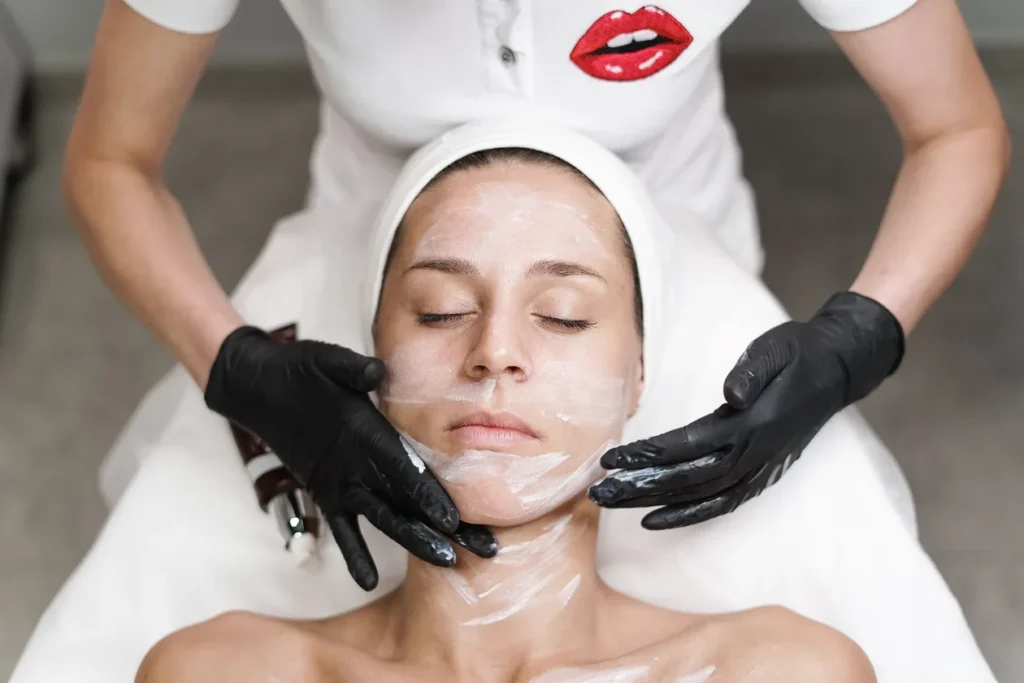
Chemical Peels McAllen can be customized based on individual skin types to ensure optimal results.
What a chemical peel actually does to your skin
A chemical peel applies an acid solution to the skin’s surface. The acid breaks down the bonds holding dead and damaged skin cells together. Those cells shed, faster and more evenly than they would on their own, and the skin underneath rebuilds with a more even texture and tone.
That’s the entire mechanism. Everything else, the specific acid, the concentration, the number of layers applied, is a dial that controls how deep the effect goes and how aggressive the shedding is.
(The clinical term for that shedding phase is desquamation. We say “peeling” in conversation because most patients would rather picture flaking skin than look up a word that sounds like a dessert course.)
Three depth categories exist, and the depth is what determines the downtime and the risk profile, not the marketing name on the treatment. The American Academy of Dermatology has a plain overview of the mechanism if you want the clinical detail before your consultation.
The three peel depths, and what each is actually for
Light (superficial) peels
Light peels affect only the outermost layer of skin, the epidermis. Typical acids include lower-strength glycolic, salicylic, or lactic acid. Downtime is minimal: mild redness for a few hours to a day, occasional light flaking. These are the peels most patients can get on a lunch break and return to normal activity the same day.
Medium-depth peels
Medium peels reach into the upper dermis. Trichloroacetic acid (TCA) at moderate strength is the classic example, and it’s one of the ingredients in the VI Peel line we use at Beautique. Downtime runs several days of visible peeling. Results are more pronounced: finer lines soften, pigmentation lifts more thoroughly, texture improves more than a light peel can manage.
Deep peels
Deep peels penetrate further into the dermis and produce the most dramatic results, along with the longest recovery (commonly one to two weeks of significant peeling and redness) and the highest risk profile. We don’t lead with these for most cosmetic concerns. The risk-to-benefit calculation rarely favors a deep peel when a series of medium peels can achieve a comparable result more safely, particularly on melanin-rich skin.

Why skin tone determines your peel, not the other way around
Dermatology classifies skin by the Fitzpatrick scale, six categories based on how skin responds to UV exposure and how much melanin it carries. Types I-III describe fair to light skin that burns before it tans. Types IV-VI describe olive, brown, and deep brown skin that tans readily and rarely burns.
Melanin is the variable that matters here. More melanin means more pigment-producing cells available to overreact to inflammation. When a peel injures the skin more aggressively than that skin can calmly recover from, those cells can overproduce pigment in response, leaving a dark patch where the original concern used to be. That’s post-inflammatory hyperpigmentation, and it’s the single biggest risk in chemical peel selection for darker skin tones. It’s also, ironically, the exact problem many patients are trying to treat when they book a peel for existing dark spots in the first place.
This isn’t a reason to avoid peels if you have olive or darker skin. It’s a reason to be more deliberate about which one you get. Published dermatology literature on chemical peels in skin of color backs this up directly: outcomes depend far more on acid selection and technique than on whether a patient with darker skin should get a peel at all.
Fair to light skin (Fitzpatrick I-III): A broader range of acids and strengths is generally well tolerated, including higher-strength glycolic and TCA formulations, with a lower risk of pigment complications.
Olive to medium-brown skin (Fitzpatrick IV): Lower-strength salicylic, lactic, and mandelic acid peels are the more conservative starting point. These acids exfoliate effectively with a gentler inflammatory response.
Deep brown and black skin (Fitzpatrick V-VI): Mandelic acid in particular is well regarded here because its larger molecular structure penetrates more slowly, producing a gentler, more even effect. Aggressive TCA or deep peels are typically avoided as a first approach.
None of this replaces an in-person assessment. Two patients with the same Fitzpatrick classification can still respond differently based on their specific skin history, sun exposure, and whether they’ve had post-inflammatory hyperpigmentation before. That’s what a consultation is for.
Why this matters more in McAllen than in most markets
Most chemical peel content online is written for a national audience and defaults to fair-skin assumptions. That’s a gap, because a significant share of patients in the Rio Grande Valley fall into Fitzpatrick IV-VI, and McAllen also sits under one of the highest average UV indexes in the United States. Sun exposure after a peel is one of the fastest ways to trigger the exact pigmentation problem a peel is often meant to solve.
We factor both variables into every peel recommendation: your baseline skin tone and how much unavoidable sun exposure your daily life actually involves. A protocol built for a patient in a lower-UV climate with fairer skin doesn’t automatically transfer here.
VI Peel at Beautique: what it treats and who it’s for
We use the VI Peel line, a medium-depth peel formulated with a blend of TCA, Retin-A, salicylic acid, vitamin C, and phenol. We offer it in a few formulations depending on what you’re treating:
- VI Peel Purify: formulated for active acne and the skin changes acne leaves behind
- VI Peel Advanced: a deeper-penetrating formulation aimed at fine lines and collagen stimulation
- VI Peel Purify with Precision Plus: combines acne treatment with targeted correction for post-inflammatory hyperpigmentation and textural scarring
- VI Peel Body: the same formulation adapted for body areas beyond the face
A single VI Peel session typically takes about 20 minutes. Because it’s a blended formulation rather than a single high-strength acid, the downtime tends to be more moderate than a comparable single-acid TCA peel at the same depth. The specific series length and spacing for your skin get set at consultation, based on what you’re treating and how your skin responds to the first session.
What chemical peels actually treat
- Acne and post-acne marks: surface exfoliation reduces active breakouts and helps fade the marks they leave behind; see our McAllen adult acne guide for how this fits into a broader acne treatment plan
- Hyperpigmentation and melasma: controlled exfoliation lifts excess pigment sitting in the upper skin layers, complementing what we cover in our guide to pigment correction
- Fine lines and rough texture: increased cell turnover improves surface smoothness over a series of sessions; patients maintaining results between peels often pair this with HydraFacial for gentler, ongoing maintenance
- Sun damage: years of UV exposure show up as uneven tone and texture. Peels address the surface layer where much of that damage sits
A peel does not address deep static wrinkles, significant volume loss, or skin laxity. Those require different treatments entirely, and we’ll tell you that directly if a peel isn’t going to get you what you’re actually asking for.
Who is and isn’t a good candidate
Good candidates:
- Patients with acne, post-acne marks, sun damage, melasma, or uneven texture
- Any Fitzpatrick skin type, provided the acid and depth are matched correctly
- Patients willing to commit to strict sun protection afterward
Wait before booking if:
- You have an active sunburn or a fresh, deep tan. Reschedule until your skin has calmed down.
- You’re currently using Retin-A, retinol, or other exfoliating actives at high frequency; your provider needs to know your full skincare routine before your first session.
- You have an active cold sore or herpes flare. A peel can trigger a wider outbreak.
- You’re pregnant or breastfeeding; several peel ingredients aren’t used during this time.
- You have a history of keloid scarring or you’ve had post-inflammatory hyperpigmentation from a previous treatment. Tell us this at consultation. It changes the recommendation.
A peel is the wrong treatment if:
- What you actually want addressed is volume loss or deep static wrinkles. That calls for dermal fillers or a different modality entirely, not exfoliation.
- You’re not able to commit to daily SPF for the weeks following treatment. Skipping sun protection after a peel undoes the result and raises your risk of the exact pigmentation problem you’re trying to avoid.
What to expect before, during, and after your peel
Before your appointment: Come in with a full list of the skincare products and medications you’re using, especially retinoids, which need to be paused beforehand. Avoid sun exposure and tanning in the two weeks prior.
During your session: The provider cleanses your skin, applies the peel solution in controlled layers, and monitors your skin’s response throughout. Most patients feel a warm or tingling sensation, not sharp pain.
After your session: Depending on depth, expect anywhere from a few hours of mild redness (light peels) to several days of visible peeling (medium peels like VI Peel). Skin will feel tight and look pink initially. Daily SPF is not optional during this window; it’s the single factor most likely to determine whether your result holds or reverses into new pigmentation. The AAD’s guidance on sun protection and dark spots in darker skin tones is worth reading before your appointment, not after.
Priscilla Aparicio, one of our licensed aestheticians, has spent 25 years watching which pigment-correction approaches actually hold up over time and which ones just look good for a few weeks before the color creeps back. That long view is exactly why we don’t default every patient to the same peel. The acid that clears a college student’s acne marks in one visit is not the acid we’d reach for on a patient with a decade of sun damage and a history of melasma.
The honest opinion we’ll give you at consultation
“Medical-grade” isn’t a protected or regulated term. Any provider can print it on a treatment menu regardless of who is actually applying the peel or what training they have in reading skin response mid-treatment. The question that actually matters is who is choosing your acid and depth, and whether they know how to recognize an early sign of post-inflammatory hyperpigmentation before it sets in, not after. That judgment is the difference between a peel that clears your skin and one that leaves you with a new problem in place of the old one.

What patients ask us before they book
Can I get a chemical peel if I have dark or olive skin?
Yes. Darker skin tones are good candidates for chemical peels. The acid and depth just need to be selected more conservatively, since melanin-rich skin has a higher risk of post-inflammatory hyperpigmentation from an overly aggressive peel. Mandelic and lower-strength salicylic acid formulations are common starting points for Fitzpatrick IV-VI skin.
What does a chemical peel actually treat?
Acne and post-acne marks, hyperpigmentation and melasma, fine lines, rough texture, and surface sun damage. It does not address deep wrinkles, volume loss, or skin laxity.
How much downtime does a chemical peel involve?
It depends on depth. Light peels involve minimal downtime, sometimes just a few hours of redness. Medium peels like VI Peel typically involve several days of visible peeling. Deep peels involve one to two weeks of recovery.
What is VI Peel and how is it different from a standard TCA peel?
VI Peel is a medium-depth peel that blends TCA with Retin-A, salicylic acid, vitamin C, and phenol rather than relying on a single acid at high strength. A session takes about 20 minutes. We offer formulations targeted at acne (Purify), fine lines and collagen stimulation (Advanced), and combined acne plus pigmentation correction (Purify with Precision Plus).
Will a chemical peel make my dark spots worse?
It can, if the wrong peel is used on your skin tone or if you skip sun protection during recovery. That’s exactly why the depth and acid selection in this guide matter, and why we assess your skin in person before recommending a specific peel rather than defaulting to one option for everyone.
How many sessions will I need?
It depends on what you’re treating and how your skin responds to the first session. Acne and texture concerns often benefit from a series; a single session can meaningfully improve tone and texture on its own. We’ll give you a realistic plan at your consultation rather than sell you a fixed package before we’ve seen your skin.
Can I wear makeup after a chemical peel?
Most providers recommend waiting at least 24 hours, and longer if visible peeling is present, since skin is more permeable and more sensitive to irritation during recovery. We’ll give you a specific timeline based on the depth of peel you received.
Beautique Medical Spa has been serving the Rio Grande Valley since 2002. We built this practice around the idea that a treatment should match the patient in front of us, not the other way around. That standard applies as much to a chemical peel as it does to Botox or a laser treatment.
If you’re considering a chemical peel in McAllen, TX (particularly if you have olive or darker skin, a history of hyperpigmentation, or you’ve been told peels “don’t work” on your skin type by someone who never actually looked at it), the right first step is a consultation where someone examines your skin before recommending anything. Book a consultation at Beautique.